The Challenge
The online fitness content space is dominated by platforms with years of domain authority and massive content libraries. Starting Strength, StrengthLog, Lift Vault, Legion Athletics, and dozens of others already rank for every major strength training keyword. Breaking into this market with a new domain means competing against sites with thousands of indexed pages and established backlink profiles.
The challenge wasn't just building a website — it was building a content platform with the architecture to scale and the depth to earn authority in a crowded niche. Strength Progression needed to:
- Organize complex fitness knowledge into a navigable, interlinked content hierarchy
- Build pillar pages deep enough to compete with established authority sites
- Create a filterable training program library that serves beginners through advanced lifters
- Target underserved niches (wrestling strength training, football-specific programming) where the big players are thin
- Support a growing blog with consistent taxonomy and cross-linking
- Include a user login system for progress tracking and personalization
- Load fast, render clean, and work perfectly on mobile — where most gym-goers browse between sets
What We Built
Strength Progression is a content platform engineered from the ground up around a pillar-page SEO architecture. Every page, every internal link, and every content taxonomy was designed to build topical authority in a specific niche — science-backed strength training with sport-specific applications. The result is a platform that competes with sites that have been publishing for a decade.
Workout. Diet. Recovery. — Three Pillars, One System
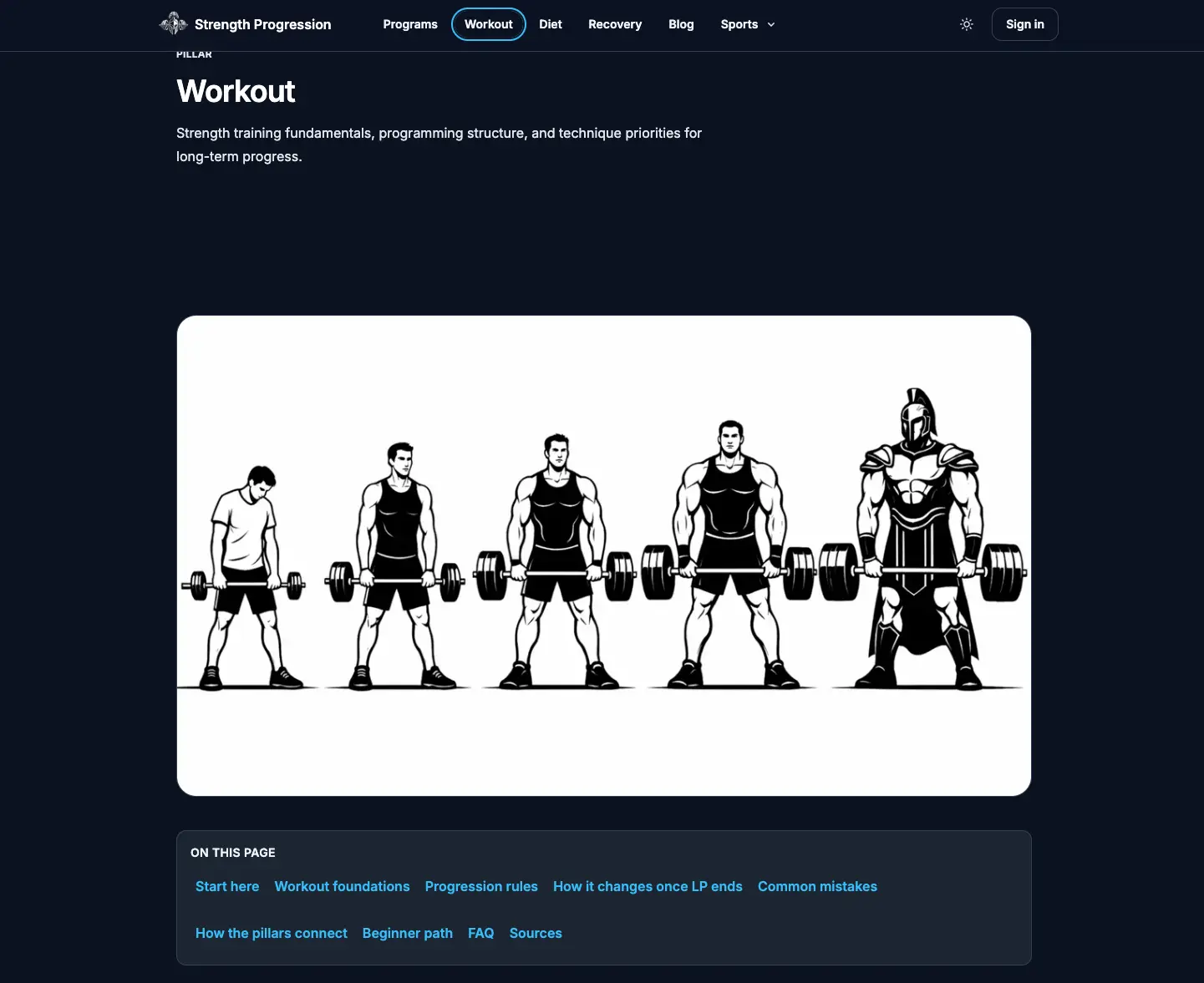
The foundation of Strength Progression is a three-pillar content model. Instead of dumping hundreds of articles into a flat blog, every piece of content maps to one of three pillars:
- Workout — Programming structure, progression methods, technique priorities, and core lift fundamentals (squat, bench, deadlift, overhead press)
- Diet — Protein strategy, energy balance, meal habits, and sport-specific nutrition for athletes managing weight classes
- Recovery — Sleep optimization, rest day strategy, stress management, deload programming, and fatigue tracking
Each pillar has its own deep-dive page — not a thin category page, but a comprehensive guide with multiple sections, internal navigation, FAQ content, and cross-links to related programs and blog posts. These pillar pages are designed to rank for broad informational queries while funneling readers into specific programs and articles.
The three-pillar model also serves as a UX framework. New visitors immediately understand the platform's scope: training isn't just about lifting — it's about the system of workout, diet, and recovery working together.
A Program Library That Serves Every Lifter
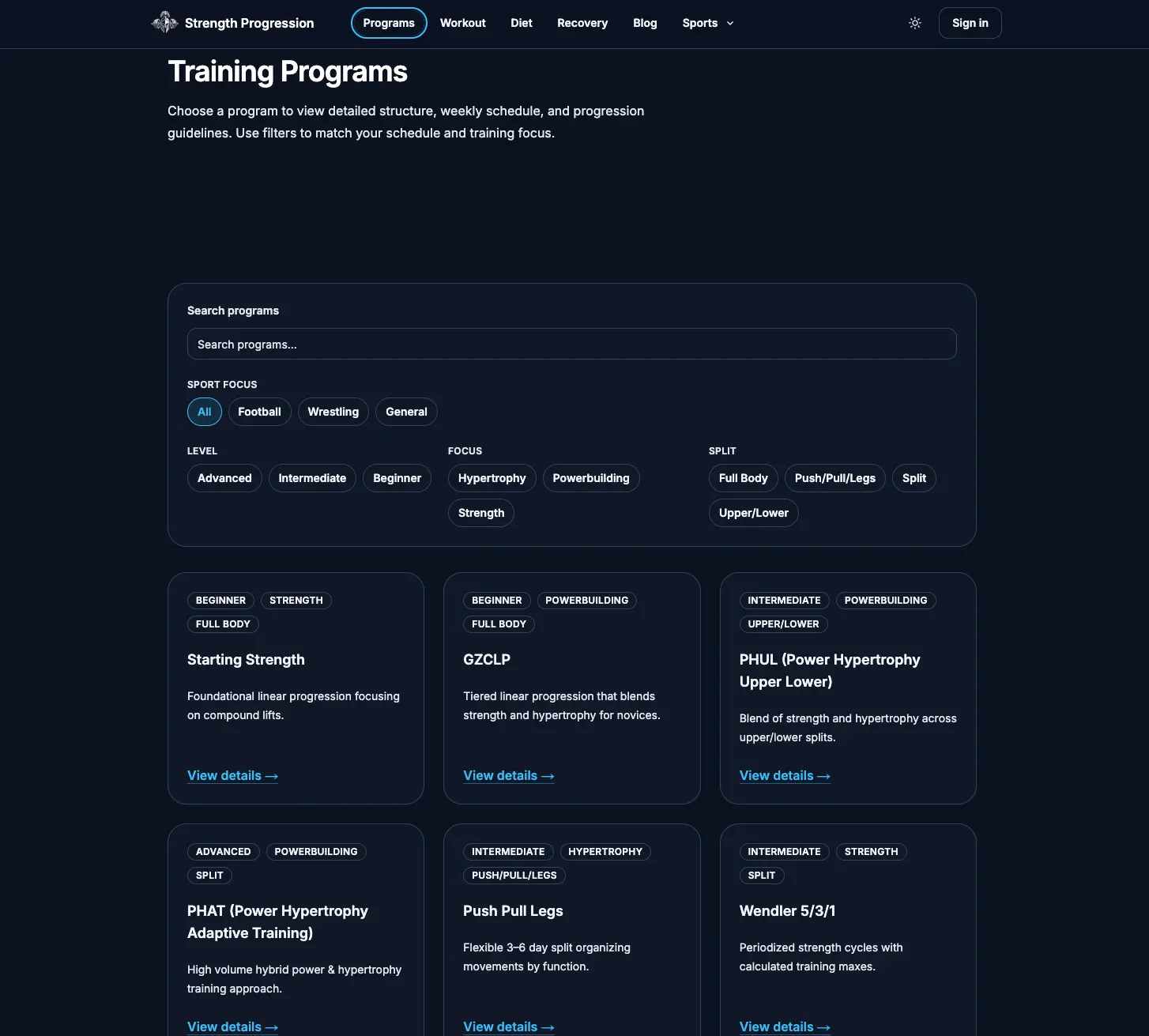
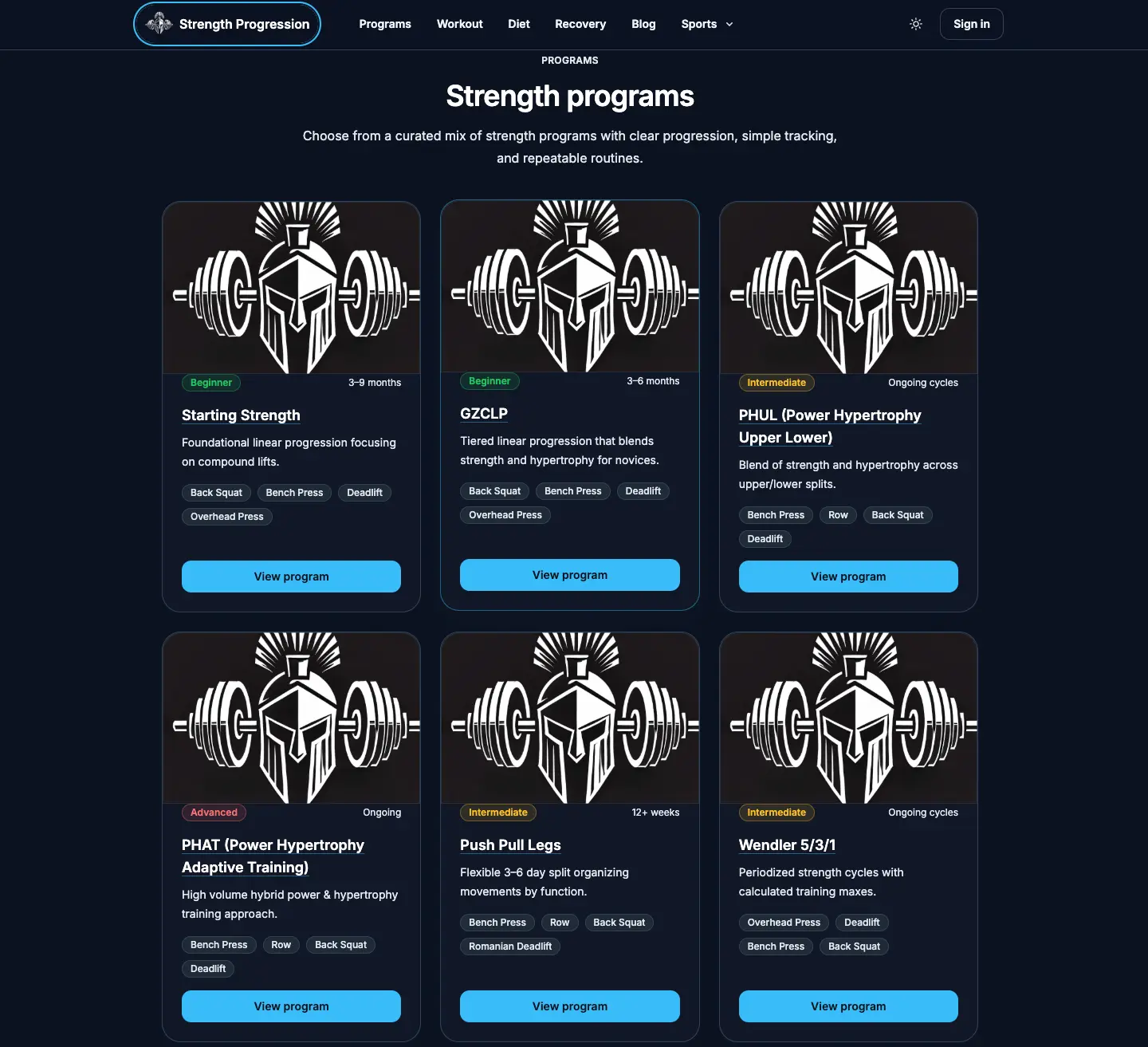
The training program library is the platform's core product. It currently features 6+ programs spanning beginner to advanced:
- Starting Strength — The classic beginner linear progression (3 days/week, 3–9 months)
- GZCLP — Tiered beginner powerbuilding with built-in progression logic
- PHUL — Power Hypertrophy Upper Lower split for intermediates
- PHAT — Advanced power hypertrophy adaptive training
- Push/Pull/Legs — Intermediate hypertrophy split (12+ weeks)
- Wendler 5/3/1 — Ongoing intermediate strength cycles
Each program page includes detailed weekly schedules, progression guidelines, exercise selection, and when-to-switch guidance.
The library features a sophisticated filtering system:
- By experience level: Beginner, Intermediate, Advanced
- By training focus: Strength, Hypertrophy, Powerbuilding
- By split type: Full Body, Upper/Lower, Push/Pull/Legs, Split
- By sport: Football, Wrestling, General
- Search: Free-text search across all programs
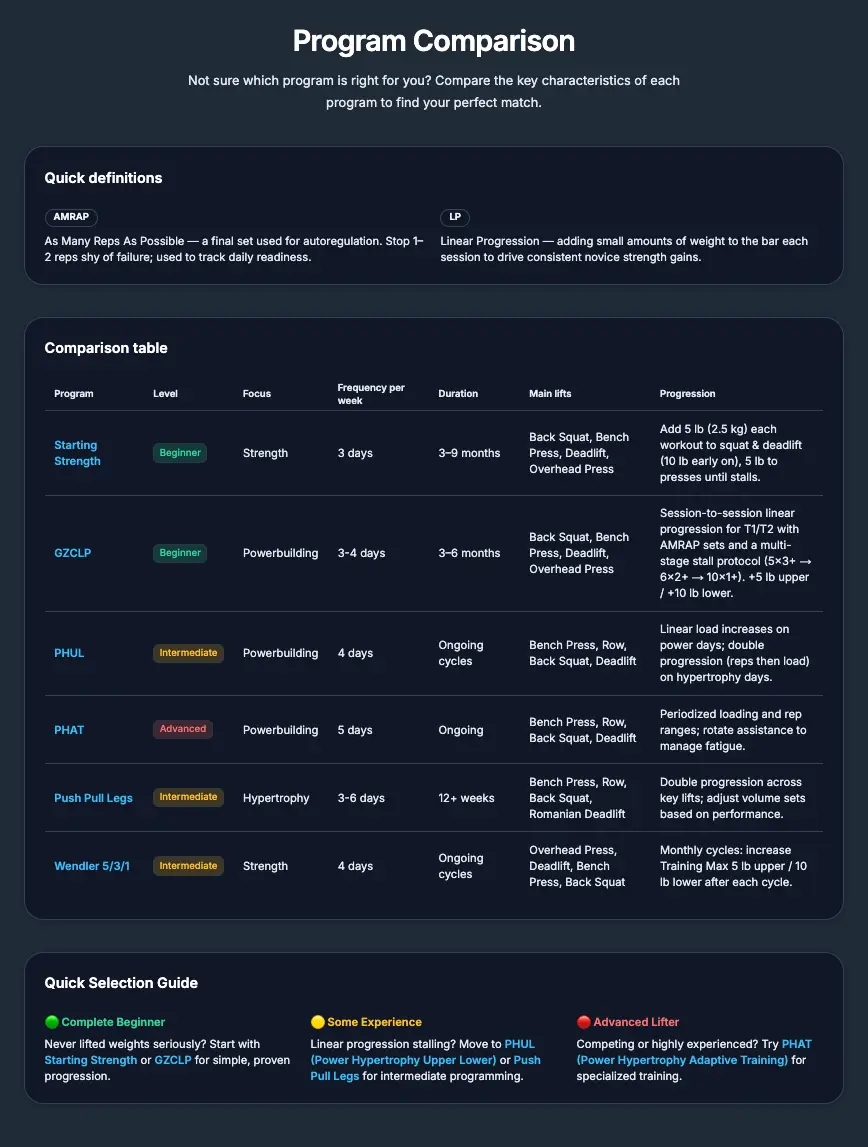
A side-by-side program comparison table lets users evaluate programs on level, focus, frequency, duration, main lifts, and progression methodology — with a color-coded quick-selection guide. This is the kind of decision tool that earns bookmarks and return visits.
Owning the Wrestling and Football Niches
Rather than competing head-on for “strength training programs” against sites with 10 years of content, we targeted underserved niches where the big players are thin: wrestling-specific and football-specific strength training.
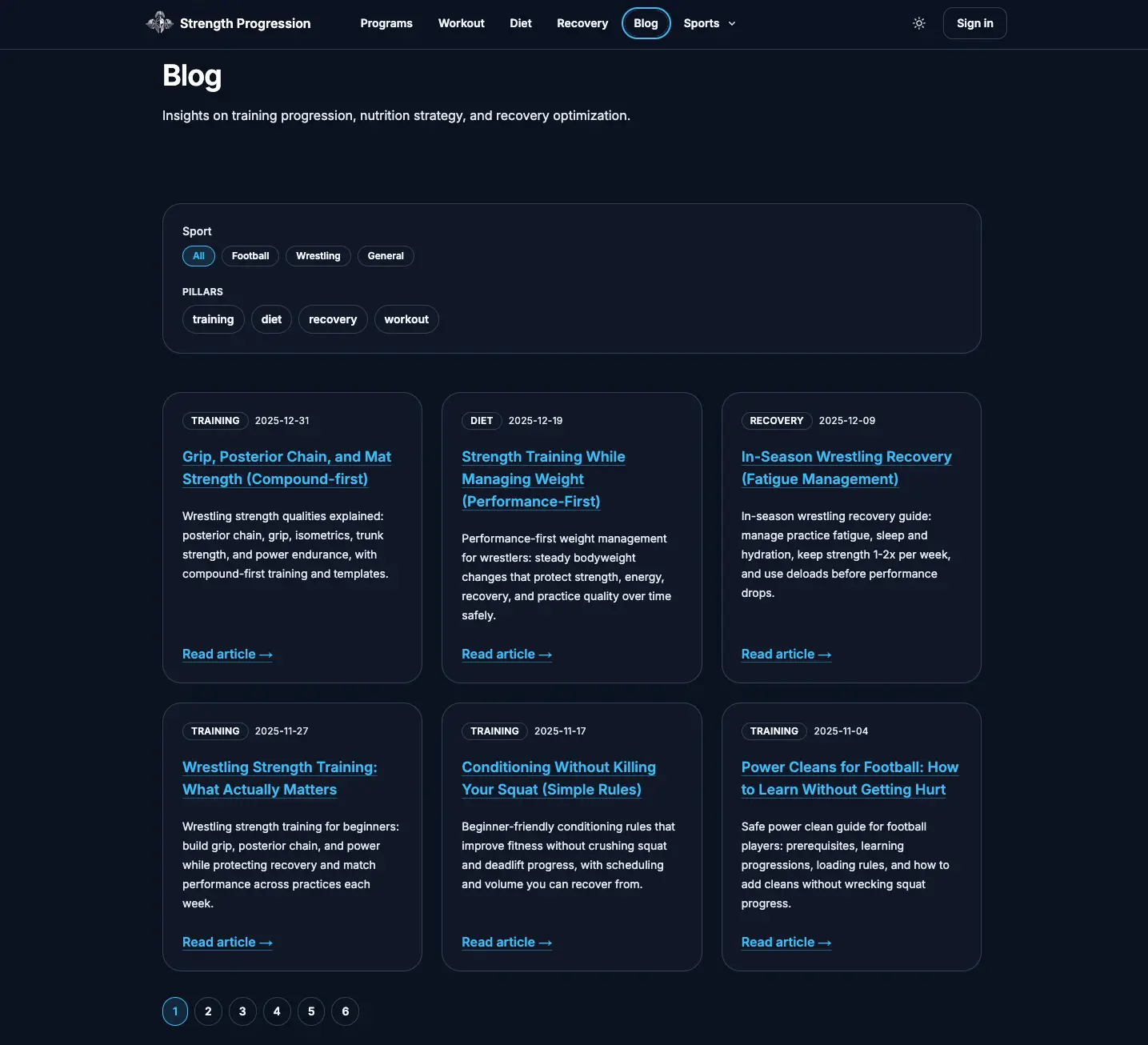
The blog features dedicated sport content:
- Grip, posterior chain, and mat strength for wrestlers
- Power cleans for football with safe learning progressions
- In-season wrestling recovery and fatigue management
- Strength training while managing weight for combat athletes
- Conditioning without killing your squat
Each piece targets a specific long-tail keyword that the major fitness sites either ignore or cover superficially. This niche-first approach builds topical authority in focused areas before expanding into broader competition.
30+ Articles With Room to Scale
The blog runs on a structured taxonomy system with filtering by sport (Football, Wrestling, General) and by pillar (Training, Diet, Recovery, Workout). Each post is categorized, dated, and cross-linked to relevant programs and pillar pages.
The publishing cadence targets 3+ posts per month with a deliberate content calendar: each post supports a pillar page's authority, targets a specific long-tail keyword, and links back to the program library. This isn't random blogging — it's a systematic content flywheel.
Pagination, search, and tag-based filtering keep the blog navigable as it scales toward hundreds of posts.
Built for Logged-In Users
Strength Progression includes a user authentication system, positioning the platform for features beyond static content:
- User accounts with login/registration
- Progress tracking (logging workouts and tracking lifts over time)
- Saved programs and personalized recommendations
- A foundation for future premium features and community
The login system transforms the site from a content resource into a product — users have a reason to come back daily, not just when they need a new program.
Dark-First Design for the Gym
The visual design is intentionally dark-first — a charcoal/navy palette with cyan accents and high-contrast typography. This isn't an aesthetic choice for the sake of it:
- Gym-goers browse on their phones between sets. Dark mode is easier on the eyes under gym lighting.
- The Spartan helmet logo and warrior branding match the audience's self-image — serious, no-nonsense, competitive.
- Clean card-based layouts make program selection and article scanning fast on mobile.
- Light mode is available via theme toggle for reading in other contexts.
What Content Architecture Delivers
Before
- ×Empty domain, zero authority, zero indexed pages
- ×Competing against platforms with 1000+ pages and decade-old domains
- ×No differentiation in a saturated market
After
- ✓3 deep pillar pages that each rival the depth of competitor landing pages
- ✓6+ training programs with detailed structure, filtering, and comparison tools
- ✓30+ blog articles with structured taxonomy and cross-linking
- ✓Sport-specific niche content targeting underserved long-tail keywords in wrestling and football
- ✓User authentication system transforming content into a product platform
- ✓Filterable program library with multi-faceted search (level, focus, split, sport)
- ✓Scalable content architecture designed to grow to 100+ articles without structural changes
Content architecture isn't about publishing more — it's about publishing smarter. Every page on Strength Progression exists in a hierarchy that passes authority upward: blog posts strengthen pillar pages, pillar pages strengthen the homepage, and the program library gives users a reason to stay. That's how a new domain competes against established players.
Pillar-Page Architecture Is How You Win SEO in Competitive Niches
Most businesses approach content marketing backwards — they publish blog posts randomly and hope Google notices. That works when you have no competition. In a niche like fitness where every keyword has ten established competitors, random publishing is a waste of money.
Pillar-page architecture flips the approach. You start with the structure: identify the 3–5 core topics your audience cares about, build comprehensive pillar pages for each, then systematically publish supporting content that links back to those pillars. Every new article strengthens the authority of the pillar above it. Over time, the compounding effect gives a new domain the topical depth to compete with sites that have been publishing for years.
Strength Progression is built on this exact model. The Workout, Diet, and Recovery pillars aren't just category pages — they're the SEO foundation. Every blog post, every program page, and every cross-link is intentional. This is the same content architecture strategy we bring to client projects when organic authority is the goal.
Built With
Inside the Program Library